English
 Fr
Fr العربية
 BI
BI 中文
中文 РФ
РФCustom Software vs SaaS: What Investors Prefer and Which Saves More Money
Understanding how software infrastructure decisions influence scalability, valuation, and investor confidence.
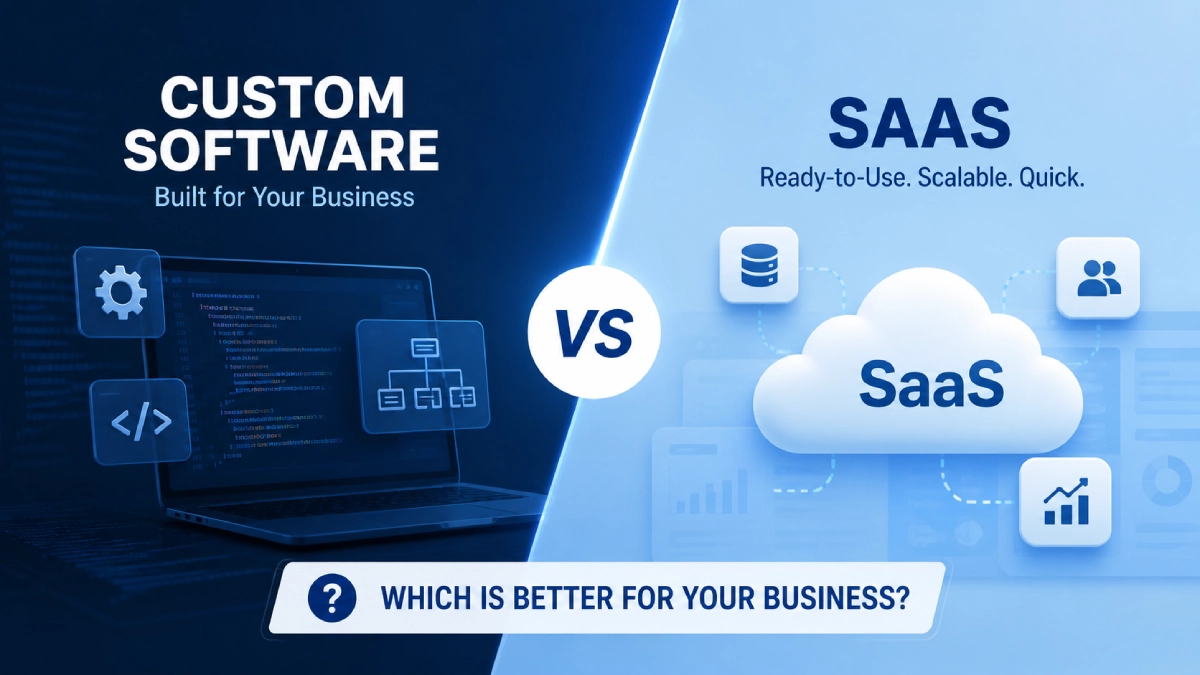
Investors evaluate far more than revenue projections and pitch decks.
They also evaluate the technology behind the business.
One of the biggest questions modern startups face is whether to rely on third-party SaaS platforms or invest in custom software systems.
The answer depends on scalability goals, operational complexity, and long-term competitive positioning.
“Investors do not simply invest in products — they invest in scalable operational infrastructure.”
What SaaS platforms provide
SaaS tools allow companies to launch operations quickly without building internal systems from scratch.
- Lower initial costs
- Faster deployment
- Minimal infrastructure management
- Prebuilt operational workflows
- Rapid startup execution
SaaS products work extremely well during early operational stages and product validation.
Where SaaS platforms become limiting
As startups scale, operational requirements become more complex.
- Limited customization
- Scalability restrictions
- Integration challenges
- Higher long-term subscription costs
- Dependency on external providers
- Operational bottlenecks
Investors often view heavy dependency on fragmented third-party systems as long-term operational risk.
Why custom software attracts investor confidence
Custom software gives startups greater control over scalability, infrastructure, and product evolution.
- Unique competitive advantages
- Scalable architecture systems
- Custom operational workflows
- Better infrastructure optimization
- Higher long-term flexibility
- Stronger intellectual property value
Investors often see custom systems as evidence of long-term strategic planning and technical maturity.
What investors actually care about
Investors are rarely focused on whether a company uses SaaS tools or custom software alone.
They focus on whether the infrastructure can support growth efficiently.
- Can the product scale reliably?
- Can operations evolve quickly?
- Does the system create defensibility?
- Can infrastructure handle growth?
- Is the technology future-ready?
The strongest startups typically combine strategic SaaS usage with custom infrastructure where differentiation matters most.
When startups should transition to custom systems
- Rapid user growth begins
- Operational complexity increases
- Third-party costs become excessive
- Custom workflows are required
- Performance optimization becomes critical
- Investor expectations increase
Transition timing is important.
Building custom systems too early can slow validation, while waiting too long can create expensive rebuilding cycles.
Why modern startups build hybrid infrastructure
Many successful companies combine SaaS platforms with custom software development.
- Third-party operational tools
- Custom backend systems
- API-first integrations
- Scalable cloud-native architecture
- Custom customer experiences
This approach balances speed, flexibility, and scalability while reducing unnecessary development overhead.
How Edge of Content helps startups scale intelligently
Edge of Content helps founders design scalable software infrastructure that supports fundraising, operational growth, and long-term technical flexibility.
- Custom SaaS development
- Cloud-native architecture
- API-first backend systems
- Scalable CRM platforms
- Modern UI/UX engineering
- Technical growth strategy
Understanding Total Cost of Ownership (TCO)
Technical leaders must evaluate solutions through the lens of TCO—encompassing integration, scalability expenses, customization limitations, and migration complexity. A comprehensive TCO analysis typically spans three to five years, accounting for both direct financial expenditures and indirect operational impacts.
The Hidden Cost Architecture of SaaS
Per-User Pricing and Scalability Economics
A $50 per-user monthly fee appears manageable, but it creates non-linear expense growth. For example:
- Salesforce: Moving from Professional ($75) to Enterprise ($150) for 200 users spikes costs from $7,500 to $30,000 monthly—a 300% increase.
- Microsoft 365: Upgrading to Premium for security adds a $9,500 monthly difference for 100 users.
- HubSpot: Professional plans start at $890/month, with steep per-user fees beyond base allocations.
Premium Features and Enterprise Gating
Essential capabilities—like SSO integration, audit logging, and customizable permissions—are often locked behind Enterprise tiers. A team may start at $50/user but discover that mandatory compliance features require an upgrade to $250/user—a 400% cost increase.
Integration Complexity and Technical Debt
Connecting SaaS tools to your ecosystem isn’t free. Third-party platforms like Zapier or Workato add recurring costs, while custom API development can cost $15,000–$50,000 in engineering time. Furthermore, API version changes create “integration fragility,” requiring constant maintenance.
Vendor Lock-In and Migration Economics
Migrating away from a SaaS platform is a major capital event. It requires data transformation, workflow redesign, and user retraining. A mid-size company migrating CRMs typically spends $50,000–$150,000 on migration services alone, not including the cost of service disruption.
When Custom Development Wins
Custom software requires higher initial investment but offers predictable cost structures. It becomes economically viable when:
- Growth Trajectories are High: Once built, your per-user cost drops to zero.
- Security is Paramount: You need complete control over data residency and compliance.
- Workflows are Unique: You stop paying for unused features and focus on what drives ROI.
1. Development Platforms (PaaS as SaaS)
Platform as a Service (PaaS) has effectively become “SaaS for Developers.” Modern platforms like Firebase, Vercel, Supabase, and AWS Amplify have removed the need for developers to manage physical servers. You pay a monthly subscription or a “pay-as-you-go” fee to access specialized environments and global hosting networks, allowing teams to scale infrastructure instantly.
2. Low-Code / No-Code Builders
Platforms like Bubble, FlutterFlow, and Webflow are pure SaaS. These are subscription-based ecosystems where the development environment and hosting are bundled. As long as you maintain your subscription, you have access to the editor and the live hosting environment for your application.
3. “Dev-as-a-Service” (The Agency Pivot)
Many agencies, including EdgeOfContent, are moving toward a “Productized Service” model. Instead of a single upfront bill, clients use a recurring subscription for continuous development, security patches, and iterative updates. It treats software as a living product rather than a one-time project.
Custom Software vs. SaaS: A Comparison
| Feature | Custom Software | Standard SaaS |
|---|---|---|
| Ownership | You own the IP and source code. | You rent the usage rights. |
| Flexibility | 100% tailored to your workflow. | Limited to vendor features. |
| Upfront Cost | Higher initial investment. | Low entry cost (Subscription). |
| Scalability | Built for your specific growth. | Instant, but may become costly. |
4. When it’s NOT SaaS
- Custom Build-and-Handover: You hire a dev for a custom app, pay once, and they hand over the full source code for you to own and host independently.
- On-Premise Software: Standalone licenses where you pay once and install the tool on a local machine with no recurring fees.
Final Thoughts
Whether building a custom CRM or a startup app, your workflow is likely powered by SaaS. Understanding this intersection is key to managing technical debt and choosing the right partners for long-term scalability.
We help startups identify where SaaS tools accelerate growth and where custom systems create long-term competitive advantage.
Investors prefer infrastructure that scales intelligently.
The best technology strategy is rarely choosing between SaaS or custom software alone — it is knowing when and how to combine both effectively.
Stop Overpaying for SaaS Seats & Build Investor-Ready Infrastructure
If your monthly subscription fees are skyrocketing, it’s time to run a TCO analysis and design software that scales intelligently with your growth.
Analyze My ROI & Start Your Project